
Never miss a story — sign up for PLANADVISER newsletters to keep up on the latest retirement plan adviser news.
Opinions October 30, 2026
A Potential ‘Bridge’ to More Lifetime Income
Prudential’s head of retirement research looks at plan participants’ interest in lifetime income beyond traditional in-plan annuities.
Reported by
David Blanchett



David Blanchett
Interest in retirement lifetime income among Americans remains high, and there is increasing attention on incorporating more lifetime income solutions, such as annuities, into 401(k) plans. This process will take time though, and today, availability remains relatively low.
One near-term option for defined contribution plan sponsors seeking to encourage participants to maximize lifetime income is to provide tools or education on the potential value of delayed claiming of Social Security retirement benefits.
There are decades of research exploring the potential benefits of delayed claiming, and the relative benefit is generally considered to be an optimal first step, given the underlying economics of the system.
However, tools to help participants determine when to optimally claim benefits appear to be relatively rare. In PGIM’s 2025 DC Plan Sponsor Landscape Survey, only 20% of plan sponsors reported offering a tool to assist with strategies for Social Security claiming, up from 13% of surveyed sponsors in 2023.
Building a Bridge
Recent survey data suggests that DC plan participants also would be interested in solutions specifically designed to support delayed claiming. For example, 62% of participants aged 55 through 65 were very or somewhat interested in a “bridge annuity” to fund income from when retirement commences until when Social Security benefits begin, potentially as late as age 70, based on data from the EBRI/Greenwald Associates 2026 Retirement Confidence Survey.
One option for funding a bridge annuity or other retirement income solution would be to dedicate a sleeve of a target-date fund explicitly labeled for lifetime income. These monies would not necessarily need to be invested immediately in an annuity, but rather in a relatively conservative investment option during the last years leading up to retirement (e.g., stable value), with the objective of encouraging participants to consider using those assets to purchase additional lifetime income at or during retirement.
Plan sponsors that immediately want to encourage more participants to allocate to lifetime income, but who are not yet offering in-plan annuities, could consider implementing strategies and solutions to help participants make more informed decisions about claiming Social Security retirement benefits.
The Impacts of Delayed Claiming
Delayed claiming of Social Security retirement benefits is one of the most widely cited retirement income planning strategies among retirement academics. PGIM’s recently updated research, “Breakeven Returns for Delayed Social Security Claiming,” analyzes the amount participants needed to earn on their investments to negate the impact of delaying Social Security.
The break–even return measures the amount a retiree would need to earn to make up the difference between early and delayed claiming. The same approach can be used to review a variety of longevity planning ages and required “hurdles” a portfolio would need to achieve to outperform the higher monthly income a participant could receive from delayed Social Security claiming. The higher the value, the more difficult it is to outperform delayed claiming. While there are limitations associated with evaluating the potential benefits of allocating to lifetime income through the lens of break–even returns, it is a relatively accessible approach for both retirees and financial advisers to understand the relative benefits.
The chart immediately below presents the estimated break–even returns for various longevity planning horizons, as well as the break–even returns for a standalone life-only annuity. Notably, this analysis incorporates some potential tax benefits associated with delayed claiming but does not incorporate spousal survivor benefits, which would further increase the break–even returns.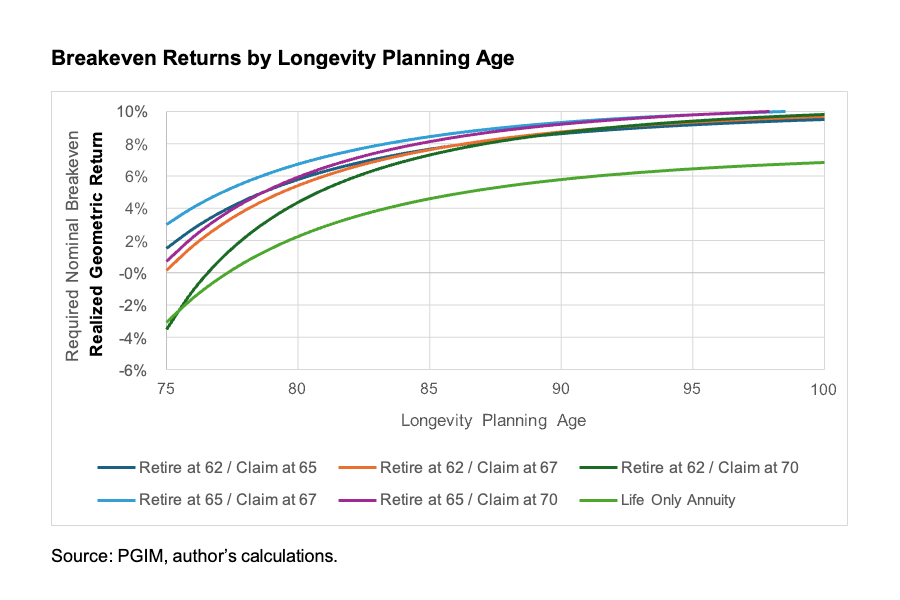
The break–even returns for most common longevity planning horizons—at least age 90—exceed 8%. Additionally, break–even returns for delayed claiming are notably higher than those for a standalone life-only annuity, which can be partially attributed to the adverse selection effect associated with lifetime income annuities. In other words, relatively healthy individuals tend to be more likely to buy lifetime income annuities, because they expect to live longer and receive payments longer, while Social Security covers the vast majority of Americans, who, on average, are less healthy than annuitants.
DC Focus on Social Security
The 2025 DC Landscape survey found that only 20% of surveyed plan sponsors provided access to a Social Security claiming tool. While it is an improvement from the 13% in 2023 that offered such tools, overall access to these types of solutions still appears to be relatively limited.
Plan sponsors looking to take things one step further could consider offering a “bridge annuity,” which is defined by the EBRI 2026 Retirement Confidence Survey as providing “a guaranteed monthly income benefit for the years between when you retire and age 70 so that you can wait to claim your Social Security benefit in order to maximize the benefit payment amount.”
The following chart shows how EBRI’s respondents answered when asked, “How interested are you in purchasing a ‘bridge annuity’ with a portion of your savings that would provide guaranteed income, like a paycheck, from the time you retire to age 70?”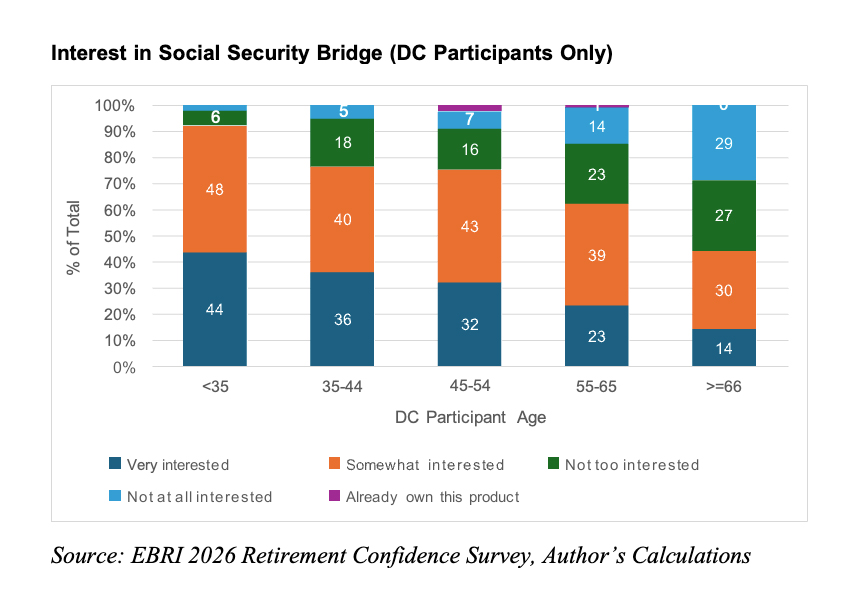
Overall, interest in a bridge annuity was relatively high, especially among younger participants. For example, 92% of workers aged 35 and younger were somewhat or very interested in a bridge annuity, compared with 62% of those aged 55 to 65.
One notable hurdle related to delayed claiming is confidence in future benefit payments. While the actual impact of potential future benefit cuts on the decision to delay is ambiguous, it is clearly a factor participants consider when deciding when to claim benefits. The chart below provides information on confidence in future Social Security benefits, based on data from the 2026 Retirement Confidence Survey.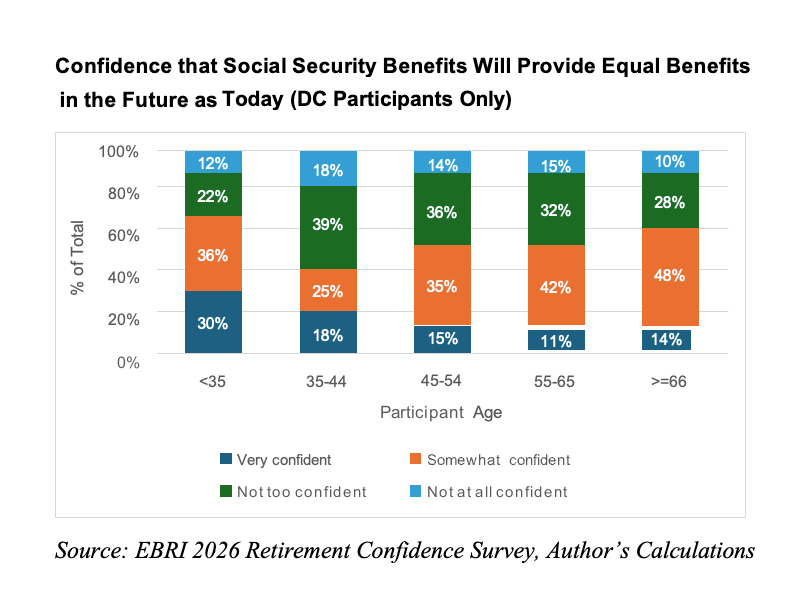
Since, according to the Social Security Administration itself, Social Security benefits even at fully funded levels, are only designed to replace about 40% of a person’s pre-retirement income, there also could be a need for additional guaranteed lifetime income to cover essential expenses, even once Social Security claiming begins.
Retirement academics often refer to an “annuity puzzle,” describing the gap between what people say they want—guaranteed lifetime income—and the relatively low rates at which retirees purchase lifetime income. Helping participants delay claiming Social Security retirement benefits is another way to increase allocations to lifetime income. Regardless of the approach selected (e.g., offering general education, a planning tool, a bridge annuity, etc.), greater awareness of delayed claiming strategies may help participants evaluate retirement income decisions as part of their broader financial planning.
David Blanchett is the head of retirement research for Prudential Financial Inc. and a portfolio manager for PGIM.
This feature is to provide general information only, does not constitute legal or tax advice, and cannot be used or substituted for legal or tax advice. Any opinions of the author do not necessarily reflect the stance of ISS STOXX or its affiliates.