
Want the latest retirement plan adviser news and insights? Sign up for PLANADVISER newsletters.
Thought Leadership November 13, 2026
Do Good Things Come to Those Who Wait? The Potential Benefits and Features of Working Longer
Sponsored by
MFS Investment Management
Thinking about retirement can be exciting. It’s an opportunity to travel more, take up new hobbies and spend more time with loved ones. Yet planning for retirement can also be stressful with many complex questions: Have I saved enough? How long do my assets need to last? What about health insurance? Am I ready to leave the workforce and my career?
What’s the best age to retire?
While good saving and investing habits are critical components of your retirement lifestyle and income, one of the most powerful tools participants have is deciding at which age to retire. Working longer has some obvious benefits, such as salary, employer benefits coverage and more time for assets to grow. Other benefits may be less apparent, such as the impact on Social Security payments and how a later retirement date can impact withdrawals from retirement accounts.
The hypothetical example below shows the impact that working longer could have on retirement savings. We looked at four participants, all age 60 and with a 401(k) account balance of $500,000. Each is projected to retire at a different age, and as you can see, working longer could have a significant impact on account balances. Youshi, Melody and Valentina saved more (both via their savings and employer contributions) than Jeff, and their savings had more time to grow.
Assumptions
- Starting Age: 60
- Account Balance: $500,000
- Salary: $80,000
- Annual Salary Increase: 2.0%
- Employee Contribution Amount: 6.0% of pay
- Employer Contribution: 4.5% of pay
- Annual Investment Returns: 6.0%
- Assumed Life Expectancy: age 85
Account Balance at Retirement
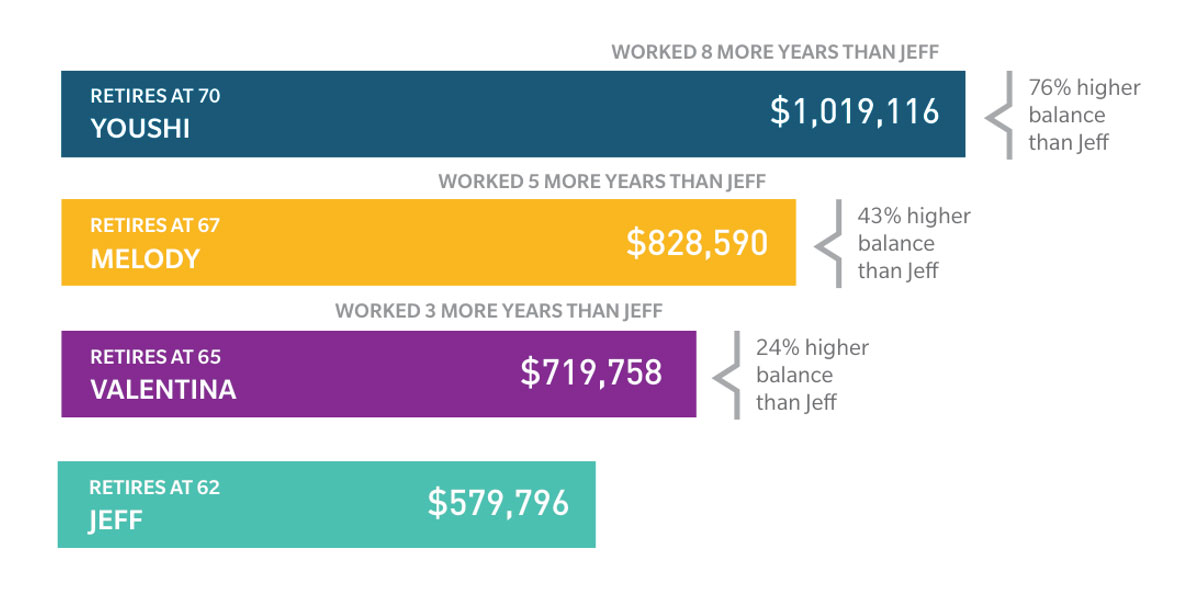
Why is Youshi’s account balance so much larger than the others?
- More savings: Youshi contributed to his retirement account over a longer period.
- More employer contributions: Youshi received an employer contribution for a longer period.
- More compounding: Youshi’s savings grew for a longer time.
Translating account balances into retirement income
Account balances are only one part of the story. What really matters is how much income a person will have in retirement, along with their expenses. Understanding Social Security and its impact on retirement income and the surviving spouse is critical. For many prospective retirees, the Social Security Full Retirement Age (FRA) is 67.1 Social Security benefits can begin at 62; however, claiming Social Security before your FRA reduces benefits.2 On the other hand, after you reach FRA, your retirement benefits grow by 8% per year until age 70.3 If you are married and you are the higher earner, at your death, your surviving spouse may step up to the benefit you were receiving.
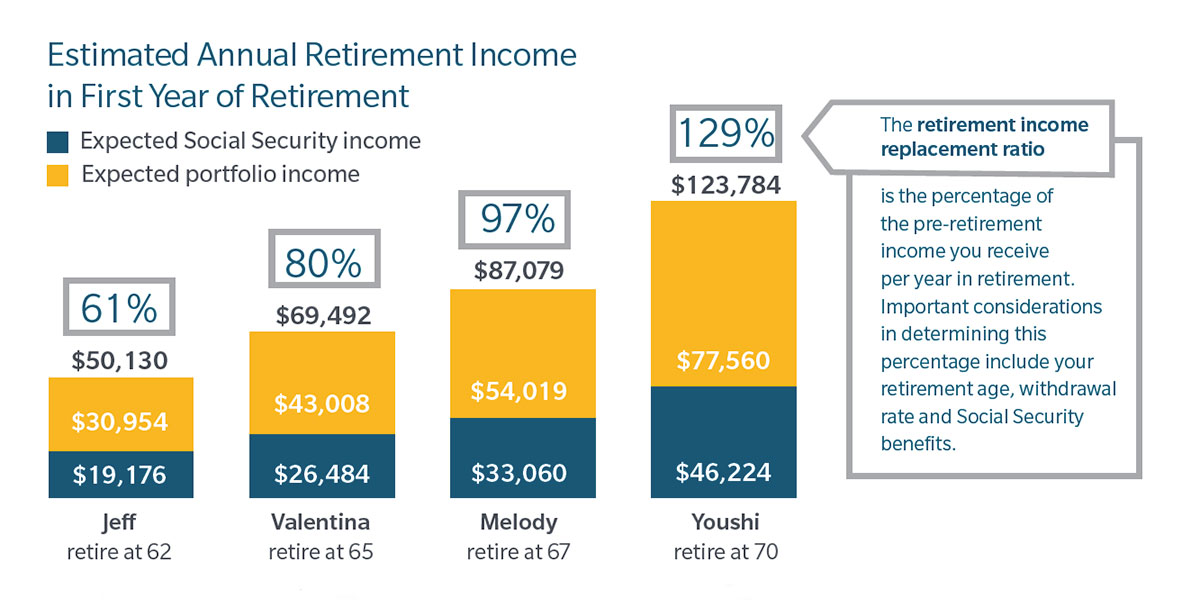
Going back to our four hypothetical pre-retirees, we estimated their potential retirement income from their 401(k) balances (bright yellow bar in the chart below) and added in their Social Security benefits (dark blue bar). Next, we determined the percentage of their pre-retirement income that would be replaced by this income (gray boxes), often called a retirement income replacement ratio. Not surprisingly, working longer and letting Social Security benefits grow could result in a significant increase in annual retirement income and a corresponding increase in income replacement at the later retirement ages.
Another important factor in the retirement date equation is Medicare health care coverage. Medicare coverage is available at 65. Retiring before age 65 may mean paying health care costs out of pocket.
Estimated Annual Retirement Income in First Year of Retirement
Key takeaway
Deciding when to retire is a personal decision based on many factors, such as health, financial goals, and needs, and working longer is not always viable. However, those who have some flexibility may want to consider weighing the pros and cons of working in retirement as a part of the retirement planning process.
1Full Retirement age is 66 years and ten months for anyone born in 1959. It is age 67 for anyone born in 1960 or later.
2 Social Security retirement benefits are reduced by 6.67% per year for the first 3 years prior to FRA and 5% per year for the next 2 years, resulting in a total reduction of 30% at age 62 for a retiree with an FRA of 67.
3 Social Security retirement benefits are increased by 8% per year after FRA, resulting in a benefit increase of 24% at age 70 for a retiree with an FRA of 67.
Important considerations and assumptions
These hypothetical examples are for illustrative purposes only and are not intended to predict the returns of any investment choices. Rates of return will vary over time, particularly for long-term investments. There is no guarantee the selected rate of return can be achieved. Any investments may have fees and expenses that are not taken into account, which would lower the performance. Regular investing does not ensure a profit or protect against loss in declining markets.
Social Security income estimates from Social Security Online as of January 2026. Amounts shown represent payment in first year of retirement, and would be subject to Social Security Cost of Living Adjustments (COLAs) in subsequent years.
Keep in mind that all investments, including mutual funds, carry a certain amount of risk, including the possible loss of the principal amount invested.
Disclosures
The views expressed are those of the author(s) and are subject to change at any time. These views are for informational purposes only and should not be relied upon as a recommendation to purchase any security or as a solicitation or investment advice from the Advisor. No forecast can be guaranteed. MFS does not provide legal, tax, accounting or Social Security advice. Individuals should not use or rely upon the information provided herein without first consulting with their tax or legal professional about their particular circumstances. Any statement contained in this communication (including any attachments) concerning US tax matters was not intended or written to be used, and cannot be used, for the purpose of avoiding penalties under the Internal Revenue Code. Contact the Social Security Administration at 1-800-772-1213 or go to www.ssa.gov to determine the benefits that may be available to you and your spouse.
MFS FUND DISTRIBUTORS, INC., MEMBER SIPC, BOSTON, MA MFSP_FLY_980302_1_26 49382.7
Sponsored by

« Keeping Calm and Invested During Declines Can Help Lead to Better Outcomes