
Never miss a story — sign up for PLANADVISER newsletters to keep up on the latest retirement plan adviser news.
Thought Leadership November 13, 2026
Keeping Calm and Invested During Declines Can Help Lead to Better Outcomes
Sponsored by
MFS Investment Management
Bear markets can be unsettling or even frightening. While some participants may be tempted to stop contributing to their retirement plans or move their assets to cash, those decisions could have serious long-term implications for their income in retirement.
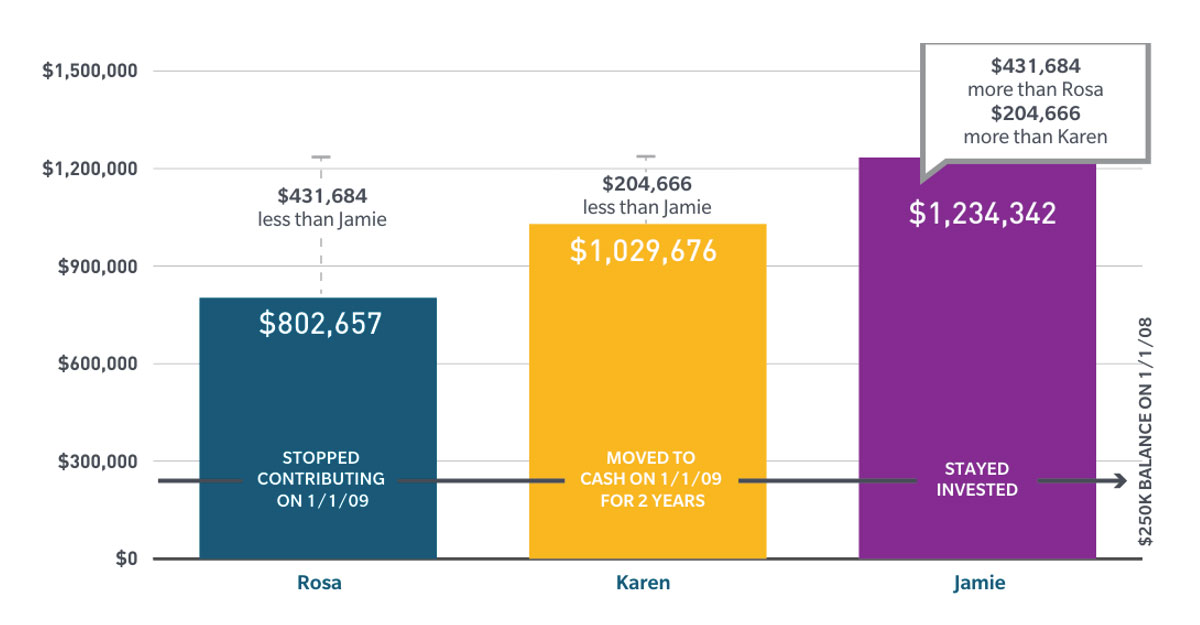
History has shown that participants who stay invested fared better over time than those who moved to the sidelines during downturns. Although past performance is no guarantee of future results, the global financial crisis of 2008 and 2009 (GFC) tells a compelling story. See how the actions of three hypothetical participants during the GFC affected their retirement account balances over a 17-year period.
Key assumptions
- Age (as of 1/1/2008): 55
- 2008 Salary: $100,000
- Balance as of 1/1/2008: $250,000
- Salary increase per year: 2%
- Employee contribution: 6% of salary
- Employer match: 4.5% of salary
- Asset allocation: – 35% US equity – 25% non-US equity – 40% US aggregate fixed income
Staying invested led to more income in retirement
Hypothetical example based on results before, during and after global financial crisis (1/1/08 – 12/31/2025)
Asset Allocation is an investment strategy that aims to balance risk and reward by apportioning a portfolio’s assets according to an individual’s goals, risk tolerance and investment horizon. Diversification is a risk management strategy that mixes a wide variety of investments in a portfolio. Rebalancing is the process of realigning the weightings of a portfolio of assets (ADR).
For purposes of this comparison, return calculations were based on monthly returns from January 1, 2008 through December 31, 2025 for the following indices — the S&P 500 Stock Index measures the broad US stock market. The Bloomberg US Aggregate Bond Index measures the US bond market. The MSCI EAFE Index (net) measures the non-US stock market. Index performance does not reflect the deduction of any investment-related fees and expenses. It is not possible to invest directly in an index. Asset allocations rebalanced monthly. Pay increases effective 1/1 of the following year. Contributions and match made at month-end. The use of a systematic investing program does not guarantee a profit or protect against a loss in declining markets. You should consider your financial ability to continue to invest through periods of low prices. Past performance is no guarantee of future results.
Keep in mind that no investment strategy, including ADR can guarantee a profit or protect against a loss. Also, all investments carry a certain amount of risk, including the possible loss of the principal amount invested.
Source: SPAR, FactSet Research Systems Inc., MFS analysis. Hypothetical examples are for illustrative purposes only and are not intended to represent the future performance of any MFS® product.
Actions can cost money
By staying invested, contributing regularly and maintaining an asset allocation based on her needs, Jamie benefited from the market’s rebound after the GFC and the compounding of new contributions and gains, leading to more retirement savings.
ROSA
Rosa’s decision to stop saving cost her $431,684 over 17 years compared to Jamie, a significant amount given that saving was already a part of her daily financial life.
KAREN
Karen’s decision to move to cash for two years cost her $204,666 compared with Jamie. While this move may have reduced stress, it is difficult to pick a market bottom. Missing the rebound and its impact on her balance might have caused more stress.
JAMIE
Jamie’s decision to stay invested means he has $431,684 more in retirement than Rosa, which could be the difference in achieving his desired lifestyle. If Jamie had saved 1% more starting 1/1/08, his account balance would have increased by $41,113 over 17 years. Volatile market environments have often presented an opportunity for participants to consider increasing their contributions.
Disclosures
“Standard & Poor’s®” and “S&P®” are registered trademarks of Standard & Poor’s Financial Services LLC (“S&P”) and Dow Jones is a registered trademark of Dow Jones Trademark Holdings LLC (“Dow Jones”) and have been licensed for use by S&P Dow Jones Indices LLC and sublicensed for certain purposes by Massachusetts Financial Services Company (“MFS”). The S&P 500® is a product of S&P Dow Jones Indices LLC, and has been licensed for use by MFS. MFS’ product(s) is not sponsored, endorsed, sold or promoted by S&P Dow Jones Indices LLC, Dow Jones, S&P, or their respective affiliates, and neither S&P Dow Jones Indices LLC, Dow Jones, S&P, their respective affiliates make any representation regarding the advisability of investing in such product(s).
Source: Bloomberg Index Services Limited. BLOOMBERG® is a trademark and service mark of Bloomberg Finance L.P. and its affiliates (collectively “Bloomberg”). Bloomberg or Bloomberg’s licensors own all proprietary rights in the Bloomberg Indices. Bloomberg neither approves or endorses this material, or guarantees the accuracy or completeness of any information herein, or makes any warranty, express or implied, as to the results to be obtained therefrom and, to the maximum extent allowed by law, neither shall have any liability or responsibility for injury or damages arising in connection therewith.
Source: MSCI. MSCI makes no express or implied warranties or representations and shall have no liability whatsoever with respect to any MSCI data contained herein. The MSCI data may not be further redistributed or used as a basis for other indices or any securities or financial products. This report is not approved, reviewed or produced by MSCI
The views expressed are those of the author(s) and are subject to change at any time. These views are for informational purposes only and should not be relied upon as a recommendation to purchase any security or as a solicitation or investment advice from the Advisor. No forecasts can be guaranteed.
Unless otherwise indicated, logos and product and service names are trademarks of MFS® and its affiliates and may be registered in certain countries.
Distributed by: U.S. – MFS Investment Management; Latin America – MFS International Ltd. Please note that in Europe and Asia Pacific, this document is intended for distribution to investment professionals and institutional use only. In Canada, this document is intended for institutional use only. Note to readers in Canada: Issued in Canada by MFS Investment Management Canada Limited. Note to UK and Switzerland readers: Issued in the UK and Switzerland by MFS International (U.K.) Limited (“MIL UK”), a private limited company registered in England and Wales with the company number 03062718, and authorised and regulated in the conduct of investment business by the UK Financial Conduct Authority. MIL UK, an indirect subsidiary of MFS®, has its registered office at One Carter Lane, London, EC4V 5ER. Note to Europe (ex UK and Switzerland) readers: Issued in Europe by MFS Investment Management (Lux) S.à r.l. (MFS Lux) – authorized under Luxembourg law as a management company for Funds domiciled in Luxembourg and which both provide products and investment services to institutional investors and is registered office is at S.a r.l. 4 Rue Albert Borschette, Luxembourg L-1246. Tel: 352 2826 12800. This material shall not be circulated or distributed to any person other than to professional investors (as permitted by local regulations) and should not be relied upon or distributed to persons where such reliance or distribution would be contrary to local regulation; Singapore – MFS International Singapore Pte. Ltd. (CRN 201228809M); Australia/New Zealand – MFS International Australia Pty Ltd (” MFS Australia”) (ABN 68 607 579 537) holds an Australian financial services licence number 485343. MFS Australia is regulated by the Australian Securities and Investments Commission.; Hong Kong – MFS International (Hong Kong) Limited (“MIL HK”), a private limited company licensed and regulated by the Hong Kong Securities and Futures Commission (the “SFC”). MIL HK is approved to engage in dealing in securities and asset management regulated activities and may provide certain investment services to “professional investors” as defined in the Securities and Futures Ordinance (“SFO”).; For Professional Investors in China – MFS Financial Management Consulting (Shanghai) Co., Ltd. 2801-12, 28th Floor, 100 Century Avenue, Shanghai World Financial Center, Shanghai Pilot Free Trade Zone, 200120, China, a Chinese limited liability company registered to provide financial management consulting services.; Japan – MFS Investment Management K.K., is registered as a Financial Instruments Business Operator, Kanto Local Finance Bureau (FIBO) No.312, a member of the Investment Trust Association, Japan and the Japan Investment Advisers Association. As fees to be borne by investors vary depending upon circumstances such as products, services, investment period and market conditions, the total amount nor the calculation methods cannot be disclosed in advance. All investments involve risks, including market fluctuation and investors may lose the principal amount invested. Investors should obtain and read the prospectus and/or document set forth in Article 37-3 of Financial Instruments and Exchange Act carefully before making the investments. Massachusetts Financial Services®
Sponsored by
