
Younger Adults Favor Self-Directed Financial Guidance Over Advisers, per Edward Jones
A study in partnership with Gallup found 75% of Gen Z adults used the internet for financial advice, compared with 14% who went to an adviser.
As younger generation savers are naturally accustomed to finding financial information online, most are turning to internet research, rather than financial advisers, for guidance.
According to Edward Jones and Gallup’s 2026 Financial Fulfillment study, 73% of all U.S. surveyed adults used online research as a source for financial guidance, compared with 32% who went to a professional financial adviser.
Among those who have sought financial guidance in the past 12 months, Millennials (79%) went to the internet as their prime source of guidance slightly more than Generation Z adults (75%) and Generation X adults (76%).
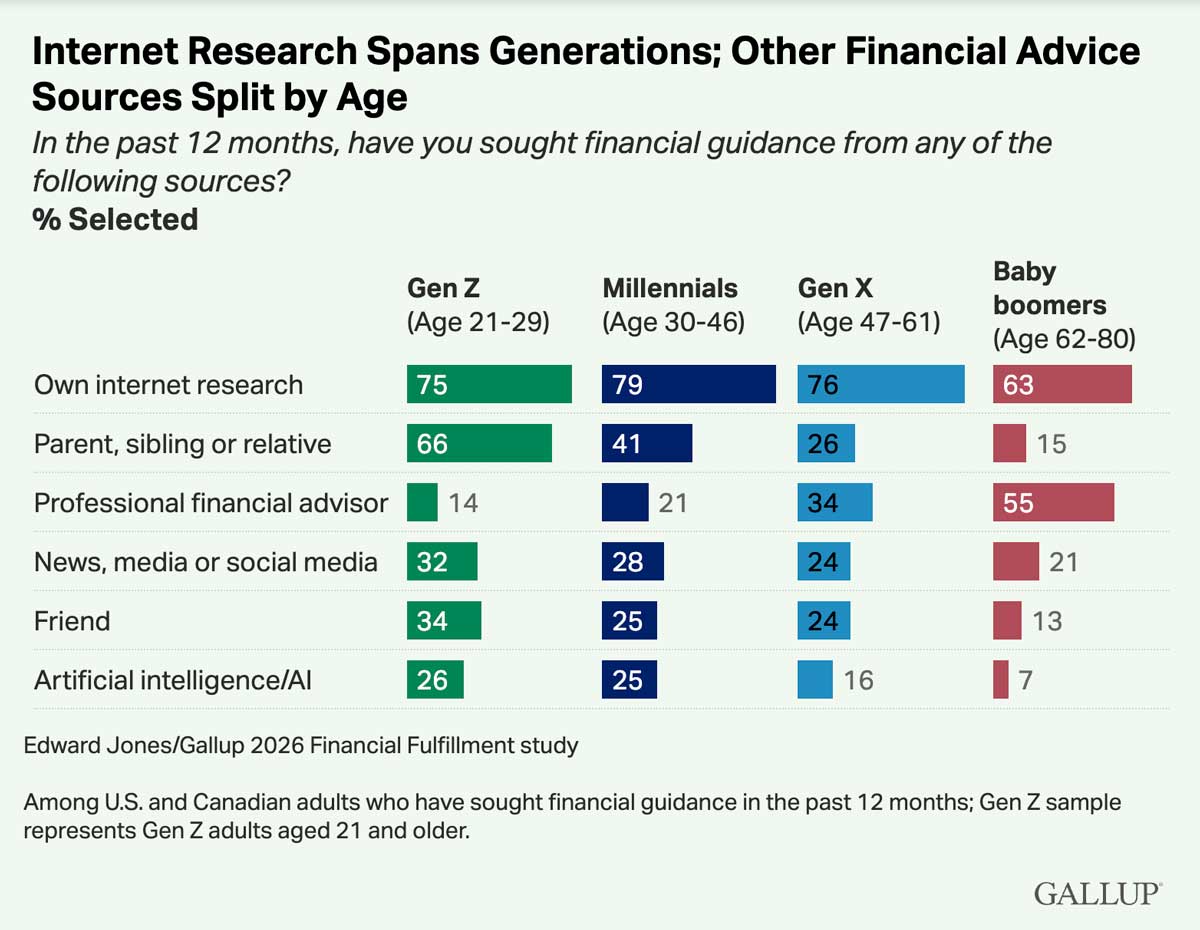
Artificial intelligence tools were more popular among younger adults than older generations. About one-quarter of Gen Z adults (26%) and Millennials (25%) reported using AI-powered tools for financial guidance, compared with just 7% of Baby Boomers.
Younger adults were more likely to use authors, speakers and influencers as sources of guidance, including 22% of Gen Z respondents and 19% of Millennials. Employer-sponsored retirement plan providers were most cited as a source of guidance by Gen X respondents (17%), followed by Gen Z adults and Millennials (14% each).
Despite the popularity of online resources, respondents had the highest level of confidence in professional financial advisers. The study found that 79% of surveyed adults expressed at least some confidence in advisers’ expertise, compared with the next-highest scorers, finance professors (64%) and family members (62%).
By contrast, less than 30% of adult respondents reported having at least some confidence in AI as a source of financial guidance. Confidence in influencers ranked even lower.
As for why younger adults increasingly turn to digital tools and self-directed research for financial guidance, the study suggested it could be due to accessibility. The study also found that financially fulfilled adults were considerably more likely to work with a financial adviser than financially stressed adults. Among U.S. respondents who sought guidance, 60% of financially fulfilled adults consulted an adviser, compared with 14% of financially stressed adults.
The study findings were based on a national survey of 5,075 U.S. adults aged 21 and older conducted from March 20 through April 6.